

NRI Guide to Buying Property in Dholera Smart City: FEMA, Loans, POA & Tax

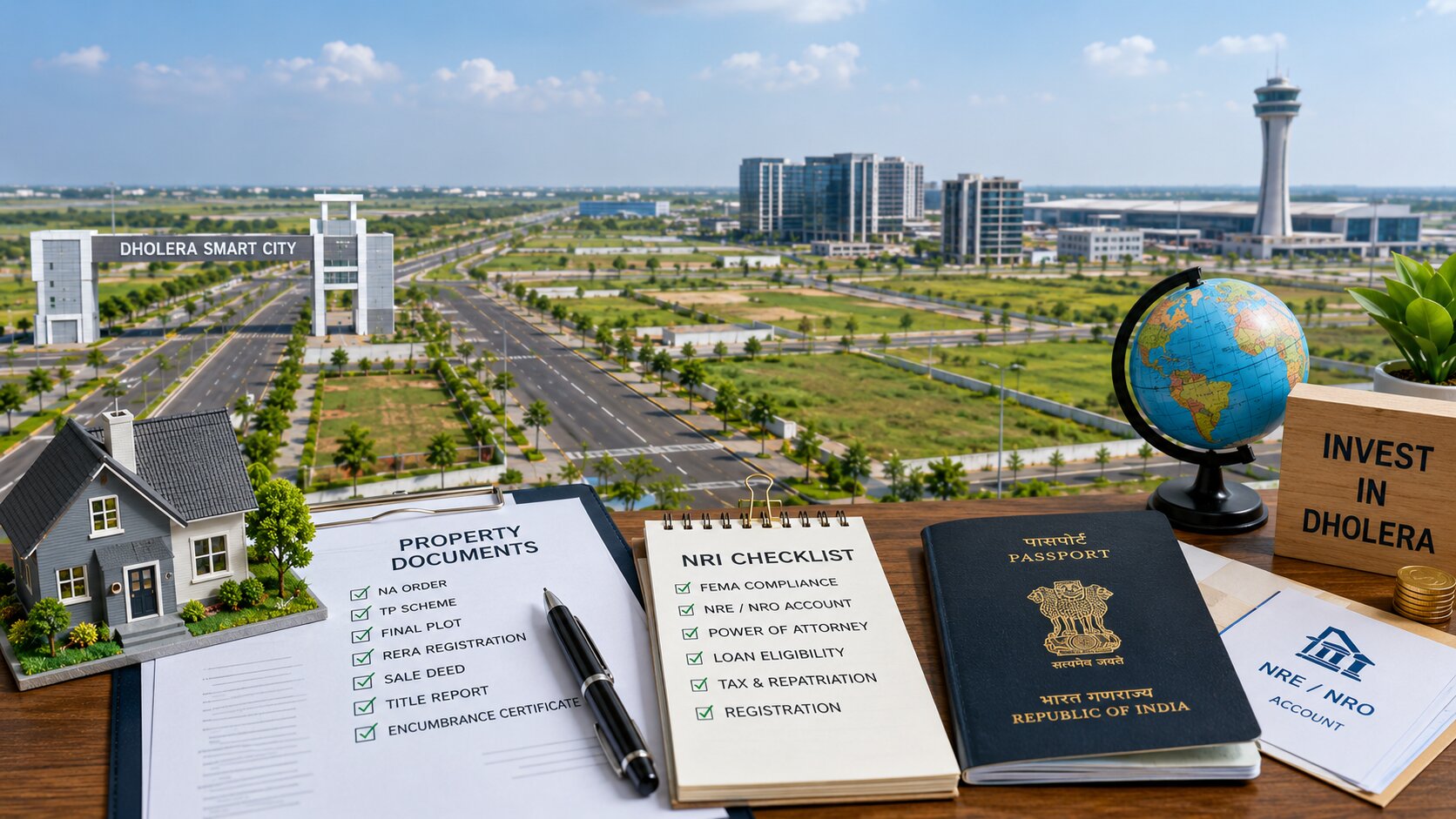
Dholera Smart City is attracting interest not only from investors across India but also from Non-Resident Indians (NRIs) and OCI cardholders looking for long-term property investment opportunities in India.
For an NRI, buying property in Dholera is possible, but the transaction needs additional attention to FEMA regulations, property classification, banking channels, Power of Attorney, taxation and repatriation rules.
The most important principle is simple: maintain proper documentation and a clear banking trail from the beginning.
Important Disclaimer: This guide is intended for general information only and should not be considered legal, financial or tax advice. FEMA, tax and banking rules can change, and their application depends on individual circumstances. Consult a qualified CA, lawyer and authorised bank before completing a transaction.
Can NRIs Buy Property in Dholera?
Generally, NRIs and OCI cardholders can purchase residential and commercial immovable property in India, subject to applicable FEMA regulations.
This can include eligible residential and commercial property in Dholera.
However, there is an important restriction.
NRIs and OCI cardholders generally cannot purchase agricultural land, plantation property or farmhouses in India.
This makes property verification particularly important in Dholera because much of the land in the wider region was historically agricultural.
Before making any payment, verify the property’s:
- Current land classification
- NA (Non-Agricultural) status
- Survey number
- Land-use zone
- TP Scheme details
- Final Plot details, where applicable
- Title and ownership
- Applicable approvals
Do not assume that a plot is eligible for NRI purchase simply because it is being marketed as a residential or investment plot.
What Can an NRI or OCI Cardholder Buy?
Here is a simple overview:
| Property Type | NRI / OCI |
|---|---|
| Residential Property | Generally allowed |
| Eligible Residential NA Plot | Generally allowed, subject to applicable rules |
| Commercial Property | Generally allowed |
| Eligible Commercial NA Land | Generally allowed, subject to applicable rules |
| Agricultural Land | Generally not permitted to purchase |
| Plantation Property | Generally not permitted to purchase |
| Farmhouse | Generally not permitted to purchase |
Because the classification of land matters, obtaining and independently verifying the relevant property documents should be one of the first steps in your purchase process.
Why NA Status Is Especially Important for NRI Buyers
NA means Non-Agricultural.
If the property being offered was previously agricultural land, don’t rely on statements such as:
- “NA is under process”
- “NA will come soon”
- “Everyone is buying here”
- “It will automatically become residential”
Ask for the applicable NA Order and have it independently verified.
The document should correspond with the actual parcel you are considering.
For an NRI buyer, verifying what the land legally is today is more important than what someone says it may become tomorrow.
FEMA Basics for NRI Property Buyers
The Foreign Exchange Management Act (FEMA) governs various foreign-exchange aspects of property transactions involving NRIs and OCI cardholders.
For a property purchase, an NRI buyer should pay particular attention to:
- Eligibility to acquire the specific property type
- Source of funds
- Permitted banking channels
- Documentation of remittances
- Tax compliance
- Future sale proceeds
- Repatriation requirements
Your specific circumstances can affect the applicable rules, so confirm the transaction structure with your authorised bank and professional advisor.
How Should an NRI Pay for Property in Dholera?
Property payments should be made through permitted banking channels.
Depending on the transaction and applicable regulations, this may involve funds remitted to India through normal banking channels and/or eligible NRE or NRO accounts.
Avoid undocumented payment arrangements.
Maintain records of:
- Overseas remittance
- Bank transfer
- NRE/NRO account transactions
- Booking payment
- Instalment payments
- Developer/seller receipts
- Registration-related payments
A clean financial trail can become particularly important when you eventually sell the property and need to establish the source and history of the investment.
NRE vs NRO: Why the Account Matters
NRIs commonly maintain NRE (Non-Resident External) and NRO (Non-Resident Ordinary) accounts in India.
The appropriate account and payment structure can depend on the source of funds and transaction.
Rather than deciding solely on convenience, speak with your bank or CA about the correct method for your particular purchase.
Keeping the transaction properly documented from day one can make future compliance considerably easier.
Can NRIs Get a Loan to Buy Property in Dholera?
Indian banks and eligible financial institutions may provide property loans to NRIs for qualifying properties.
Loan approval is not automatic.
Lenders may evaluate factors such as:
- Applicant’s country of residence
- Employment/business profile
- Income
- Creditworthiness
- Age
- Property type
- Property approvals
- Legal title
- Project/developer
- Loan-to-value ratio
- Repayment capacity
For plot purchases, eligibility can differ from a conventional home loan.
Therefore, if you intend to finance your Dholera property, it is advisable to check loan eligibility before paying a substantial booking amount.
Power of Attorney (POA) for NRI Property Buyers
One of the biggest practical challenges for NRIs is being physically present in India for every stage of the transaction.
A properly structured Power of Attorney (POA) can allow an authorised representative to carry out specified activities on your behalf.
Depending on how the POA is drafted and applicable requirements, the authorised person may be able to assist with matters such as:
- Documentation
- Signing specified documents
- Liaising with the developer or seller
- Registration-related formalities
- Taking possession
- Other specifically authorised activities
Don’t Use a Generic POA Without Legal Review
A Power of Attorney should clearly define what the representative is and is not authorised to do.
Have the POA prepared or reviewed by a qualified lawyer.
Depending on where it is executed and how it will be used in India, additional procedures such as notarisation, attestation/apostille and adjudication/stamping may be applicable.
Confirm the exact procedure before relying on the document for registration.
Documents NRIs Typically Need
The exact documentation depends on the buyer, property, lender and transaction structure.
Commonly requested documents may include:
Identity & Residency Documents
- Valid passport
- OCI card, where applicable
- PAN card
- Overseas address proof
- Passport-size photographs
- Indian address proof, if applicable
Financial Documents
Depending on whether the property is self-funded or financed:
- NRE/NRO account details
- Bank statements
- Overseas bank statements
- Income proof
- Salary slips
- Employment documents
- Tax documents
- Remittance records
Property Documents
The buyer should also independently verify applicable property documentation, including:
- Title documents
- Land records
- Survey number
- NA Order
- TP Scheme details
- Final Plot details
- Layout approvals
- RERA registration, where applicable
- Encumbrance/charge information
- Previous sale deeds/title chain
Remote Purchase Documents
If you are not travelling to India for the transaction:
- Properly executed Power of Attorney
- Applicable attestation/apostille
- Other documentation required for its use in India
NRI Dholera Property Buying Process
A well-organised transaction can follow a process such as:
Step 1: Define Your Investment Objective
Decide whether you are looking for:
- Residential property
- Long-term land investment
- Commercial property
- Future self-use
- Investment diversification
Step 2: Verify Property Eligibility
Confirm that the property type can legally be purchased by you under the applicable regulations.
Step 3: Check Land Classification
Survey Number → Zone → NA Status → TP Scheme → Final Plot
Step 4: Conduct Legal Due Diligence
Engage an independent property lawyer to examine the title, ownership, approvals and transaction documents.
Step 5: Plan Your Fund Route
Discuss the proposed payment structure with your bank and CA.
Maintain a documented trail for every payment.
Step 6: Arrange Financing if Required
If you require a loan, obtain preliminary eligibility and property acceptance from the lender before committing substantial funds.
Step 7: Arrange POA if Required
If you cannot be physically present in India, prepare the required Power of Attorney well before registration.
Step 8: Visit or Independently Verify the Site
Ideally, visit Dholera personally.
If that is not possible, arrange reliable physical verification of the plot, its access, boundaries and surrounding development.
Step 9: Complete Registration
After legal and financial verification, proceed with the applicable sale deed and registration formalities.
Tax Considerations for NRI Property Buyers
Taxation can differ depending on the transaction, property value, residency status and applicable law.
NRIs should discuss the tax implications with a qualified Chartered Accountant before completing the purchase.
Important areas to understand include:
- Applicable TDS requirements
- Stamp duty
- Registration charges
- Income from property, if applicable
- Tax treatment when the property is sold
- Capital gains
- TDS applicable at the time of future sale
- Repatriation of eligible sale proceeds
Keep all tax certificates, payment records and transaction documentation safely.
Repatriation of Property Sale Proceeds
If you eventually sell your Dholera property and want to transfer eligible proceeds outside India, the transaction will be subject to the applicable FEMA, banking and tax requirements at that time.
This is another reason to maintain a clean record from the original purchase.
Keep:
- Original inward remittance records
- NRE/NRO transaction records
- Purchase agreement
- Registered sale deed
- Payment receipts
- Tax documents
- Bank statements
- Subsequent sale documentation
A properly documented purchase can simplify the compliance process when the property is eventually sold.
NRI Dholera Property Checklist
Before finalising your purchase, check:
- ☐ Property type is eligible for NRI/OCI purchase
- ☐ Agricultural status checked
- ☐ NA status independently verified where applicable
- ☐ Survey number verified
- ☐ Land-use zone confirmed
- ☐ TP Scheme checked
- ☐ Final Plot details verified where applicable
- ☐ Seller’s ownership verified
- ☐ Title chain checked by an independent lawyer
- ☐ RERA details checked where applicable
- ☐ Encumbrances checked
- ☐ Site physically verified
- ☐ Fund-routing method confirmed
- ☐ NRE/NRO documentation maintained
- ☐ PAN and KYC documents ready
- ☐ Loan eligibility checked if financing is required
- ☐ POA properly prepared if buying remotely
- ☐ Tax implications discussed with a CA
- ☐ Registration documents independently reviewed
Common Mistakes NRI Buyers Should Avoid
Buying Without Checking Land Classification
Never assume that every plot marketed around Dholera is eligible for NRI purchase.
Sending Money Before Legal Verification
Do not allow urgency or a limited-time offer to replace due diligence.
Using an Incorrect or Incomplete POA
A poorly drafted POA can create problems when documents need to be executed or registered.
Ignoring the Banking Trail
Keep every payment traceable and documented.
Depending Entirely on the Seller’s Lawyer
Consider obtaining independent legal advice representing your interests as the buyer.
Buying Without Understanding the Exit
Think about taxation, liquidity and potential repatriation before buying — not only when you decide to sell.
Is Dholera Suitable for NRI Investors?
Dholera can be considered by NRIs looking for exposure to a long-term planned development in India.
Its investment proposition is linked to factors such as:
Planned Infrastructure → Connectivity → Industrial Development → Employment → Future Residential & Commercial Demand
However, these factors do not make every property in Dholera equally attractive.
For an NRI investor, a stronger approach is:
Eligible Property + Correct Zone + Clear Title + Verified Approvals + Clean Fund Trail + Independent Due Diligence + Long-Term Perspective
The objective should not simply be to buy property in Dholera.
It should be to buy the right, legally eligible and properly documented property at an appropriate price.
Looking to Buy Property in Dholera from Abroad?
Realty Rise Group assists NRI and OCI buyers evaluating residential and commercial property opportunities in Dholera SIR.
You can shortlist suitable properties based on your investment objective, budget, preferred location and holding horizon before planning the next steps.
For legal, FEMA and tax matters, obtain advice specific to your circumstances from qualified professionals.